From Afterthought to Architecture: Inside Nigeria’s National Policy Dialogue on Private Sector Integration in Maternal Health
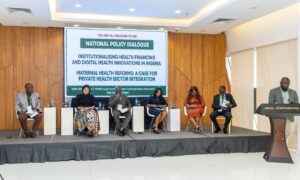
Abuja, 30 July 2026 — On a bright Thursday morning at the Abuja Continental Hotel, government officials, bankers, doctors, digital health innovators, the private health sector, and development partners gathered to address a single, urgent question: how do we finally bring Nigeria’s private health sector — the first primary healthcare’s contact for 60 to 70 percent of Nigerians — into the architecture of national health financing and digital health reforms?
The occasion was the National Policy Dialogue on Institutionalising Health Financing and Digital Health Innovations in Nigeria: Maternal Health Reforms — A Case for Private Health Sector Integration, convened by the Federal Ministry of Health and Social Welfare in collaboration with ACIOE Foundation and the Nigeria Health Watch.
For ACIOE Foundation, which leads the advocacy component of the Maternal Health Advocacy and Communications (MHAC) Project supported by MSD for Mothers, the dialogue represented the culmination of nearly two years of evidence-gathering, stakeholder engagement, and relationship-building across Ekiti, Kaduna, and Lagos States. It was also, in the words of the panel discussion session moderator, Dr. Hameed Adediran, a deliberate attempt to move the conversation “beyond identifying challenges to securing concrete policy commitments.”
Why This Conversation Matters Now
Nigeria’s maternal mortality numbers remain among the most sobering in the world. The country’s maternal mortality ratio sits at approximately 572 deaths per 100,000 live births. Nearly 75 percent of health spending is still paid out-of-pocket by households, and less than 10 percent of Nigerians currently have any form of health insurance.
Set against that backdrop is a private health sector that is too big to keep treating as an afterthought. Nigeria has close to 40,000 functional hospitals, of which nearly 10,000 are privately owned. An estimated 206,000 Patent and Proprietary Medicine Vendors (PPMVs) and Community Pharmacists form one of the largest frontline healthcare networks anywhere in Africa, and roughly 65 percent of them are women-owned or women-led. In Lagos State alone, there are over 3,000 private hospitals, more than 3,000 community pharmacies, and over 11,000 PPMVs.
Despite this scale, private providers remain thinly integrated into national financing mechanisms, digital health systems, and policy design. That gap between how much the private sector does and how little it is formally recognised for doing it was the rousing problem of the day.
Setting the Context
The dialogue opened with remarks from Mrs. Iyadunni Olubode, Director of MSD for Mothers, Nigeria and Kenya, who challenged participants to see maternal health as a moral obligation that transcends professional duty, and reminded the room that “posterity would judge today’s generation” on what was done, not merely discussed. Mr. Olukunle Daramola, Director of ACIOE Foundation, welcomed dignitaries from across government, banking, private healthcare, and civil society, framing private sector integration as “a strategic partnership rather than merely stakeholder participation.”
Goodwill messages followed from the Central Bank of Nigeria, Nigeria Health Watch, the Association of Nigerian Private Medical Practitioners, the Clinton Health Access Initiative, the Nigerian Medical Association, and the Federal Ministry of Health & Social Welfare Reproductive Health Division – each affirming, in different language, the same conviction: policy conversations must now translate into implementation.
Christian Simon, ACIOE Foundation’s Monitoring and Evaluation Lead, then grounded the day in evidence, presenting findings from the MHAC Project’s assessment across the three implementation states. Among the sharpest findings: 70 to 80 percent of private facilities that applied for credit failed eligibility requirements because of inadequate documentation and weak financial management systems, a reminder that financing gaps and institutional readiness gaps are deeply intertwined.
Innovations Already Proving the Model
Four presentations showcased what happens when financing, digital tools, and quality improvement are combined deliberately:
- Helium Health’s Maternal Health Fund, which blends affordable financing with quality improvement and digital health tools, and whose underlying Helium Credit platform has already disbursed roughly US$11 million in loans to more than 450 healthcare facilities, at a 93 percent repayment rate.
- SCIDaR’s and SFH PACs Project, which has channelled financing through a Wema Bank partnership to 156 micro, small, and medium healthcare enterprises, 97 of them women-led, while maintaining a Portfolio at Risk below 1 percent — comfortably outperforming the Central Bank of Nigeria’s 5 percent benchmark.
- PharmAccess Foundation’s MOMCare framework, a value-based maternal healthcare model already supporting roughly 87,000 pregnant women across Kenya and Tanzania, now piloting in Lagos with LASHMA around Ikorodu LGA.
- Kaduna State’s digital health insurance reforms, which nearly doubled enrolment, from about 4.5 percent to 9.6 percent, within two years through digital transformation.
These weren’t abstractions. They were live proof that when private health providers are given the right financing structures and digital tools, improved outcomes and sustainability are evident.
Presenting the National Advocacy Agenda
Following the technical presentations and a panel discussion moderated by Dr. Hameed Adediran, Country Director of Care Network Medical Aid Foundation, ACIOE Foundation’s Advocacy Lead, Adenike Badiora, took the floor to present the project’s National Advocacy Agenda: “Integrating Nigeria’s Private Health Sector into National Health Financing and Digital Health Strategies: From Afterthought to Architecture.”
Drawing on the assessment data and the innovations showcased earlier in the day, the presentation set out ACIOE Foundation’s National Advocacy Asks, calling on government and partners to:
- Accelerate amendment and implementation of the Basic Health Care Provision Fund (BHCPF)
- Ring-fence 30 percent of BHCPF funding specifically for maternal and child health services
- Fully integrate private healthcare providers into the National Digital Health Initiative (NDHI) architecture
- Fast-track passage of the National Digital Health Bill
- Strengthen mandatory health insurance implementation while expanding accreditation of private providers
- Publish and implement a National Private Health Sector Maternal Health Engagement Framework
- Establish blended financing mechanisms with affordable lending windows for private providers
- Scale proven digital health innovations through government budgets, not donor funding alone
- Mobilise domestic resources, including dedicated health taxes and the proposed Mama Fund
“Donor funding continues to decline,” the presentation stressed, “making it imperative for Nigeria to develop sustainable domestic solutions while recognising the private health sector as a strategic partner rather than an afterthought.” The message to the room was direct: move “from pilot projects to national policy, and from afterthought to architecture.”
Commitments in the Room
What distinguished this dialogue from a routine convening was the willingness of institutions to commit publicly to specific actions:
- Dr. Philip Ekpe, representing the Nigerian Medical Association, reminded participants that “no woman should die while giving life,” and pledged NMA’s continued support for maternal health reforms.
- First City Monument Bank (FCMB) announced a ₦20 billion healthcare financing fund, building on more than ₦1 billion already disbursed through its collateral-free healthcare loans.
- Wema Bank confirmed default rates below 1 percent on its concessionary healthcare lending pilots in Kaduna and Lagos and committed to digitising its lending process to reach PPMVs directly.
- NPHCDA reaffirmed its commitment to deepening private sector collaboration, particularly under the Maternal Mortality Reduction Innovation and Initiatives (MAMII) programme.
- The Federal Ministry of Health and Social Welfare pledged to transmit the advocacy recommendations to the Honourable Minister and confirmed that the National Digital Health Information Exchange initiative approved in 2024 is targeting full implementation by May 2027.
Copies of the National Advocacy Brief were formally handed over to representatives of the Federal Ministry of Health and Social Welfare, NPHCDA, the Federal Ministry of Women Affairs, NHIA, UNFPA, the Central Bank of Nigeria, Wema Bank, FCMB, and Nigeria Health Watch — a milestone ACIOE Foundation regards as the start of sustained follow-up, not the end of the conversation.
What Comes Next
The dialogue closed with a clear-eyed acknowledgement that policy commitments only matter if they are tracked and delivered. ACIOE Foundation has committed to coordinating follow-up on the advocacy brief and the commitments made in the room, and to continuing to work with the Federal Ministry of Health and Social Welfare, financial institutions, and private health sector partners to convert these pledges into implemented policy.
As the MHAC Project’s evidence makes clear, Nigeria already has the policy instruments, the innovations, and, as this dialogue demonstrated – a growing coalition of institutions willing to act. What remains is the discipline of institutionalisation: turning proven pilots into national architecture and treating the private health sector not as an afterthought, but as the strategic partner it has always been.
The Maternal Health Advocacy and Communications (MHAC) Project is implemented by ACIOE Foundation, which leads the advocacy component, and Nigeria Health Watch, which leads strategic communications, with support from MSD for Mothers. The project works in Nigeria to strengthen maternal healthcare financing and digital health integration within Nigeria’s private health sector space.